How to Buy a Pontoon Boat for Lake Lanier
Everything you need to know before buying a pontoon boat for Lake Lanier or Lake Norman — size, engine, features, and budget tips from our experts.

Lake Lanier is one of the Southeast's most popular boating destinations — 38,000 acres of clear water, 692 miles of shoreline, and warm Georgia summers that practically demand you spend them on the water. Whether you're a first-time buyer or upgrading from an older boat, choosing the right pontoon is one of the most important decisions you'll make.
We've helped thousands of families find their perfect boat at our Lake Lanier and Lake Norman locations. Here's everything we've learned about what actually matters when you're shopping for a pontoon.
1. Start With How You'll Actually Use It
Before you look at a single spec sheet, think honestly about how your family will use the boat. This single question shapes every other decision.
Casual cruising and swimming — If your weekends look like anchoring in a cove, floating in the water, and grilling on the back deck, you want comfort over performance. Wide beam, plush seating, a swim platform, and a Bimini top matter more than top speed.
Entertaining and socializing — Hosting friends and family means you need seating capacity, a good sound system, and a layout that lets people move around easily. Look for models with rear-facing lounge seats and a wet bar option.
Watersports and tubing — If you're pulling tubes, wakeboards, or skis, you need real power. A tritoon (three-tube pontoon) with a 200 HP or larger engine will give you the lift and speed to make it fun. Our Godfrey pontoons with performance packages can hit 52 MPH — more than enough to get the kids airborne.
Fishing — Fishing-focused buyers should look for livewell options, rod holders, and a quieter engine profile. A 115–150 HP Honda four-stroke is ideal here: fuel-efficient, whisper-quiet, and reliable.
2. Understand the Size and Capacity Math
Pontoon boats are measured by deck length, but the number that really matters is passenger capacity. Georgia law requires you to stay within the boat's rated capacity, and Lake Lanier's busy summer weekends mean you'll want room to breathe.
Here's a rough guide:
- 20–22 feet: Great for couples and small families (6–8 people). Easier to dock and trailer.
- 23–25 feet: The sweet spot for most families (10–12 people). Enough room for a full day without feeling cramped.
- 26–28 feet: Ideal for entertaining or large groups. Requires a bigger slip and more experience docking.
One thing buyers often overlook: beam width. A wider beam means more stable, more deck space, and a better ride in chop. Lake Lanier can get rough on windy afternoons, so don't underestimate this.
3. Two Tubes vs. Three Tubes (Tritoon)
This is the question we get most often, and the answer is simple: if you want performance, go tritoon.
A standard pontoon has two aluminum tubes (logs) under the deck. A tritoon adds a center tube, which does three things:
- More lift — The boat rides higher in the water, reducing drag
- More speed — Same engine, meaningfully faster (often 8–12 MPH more)
- Better handling — Tritoons corner more like a sport boat
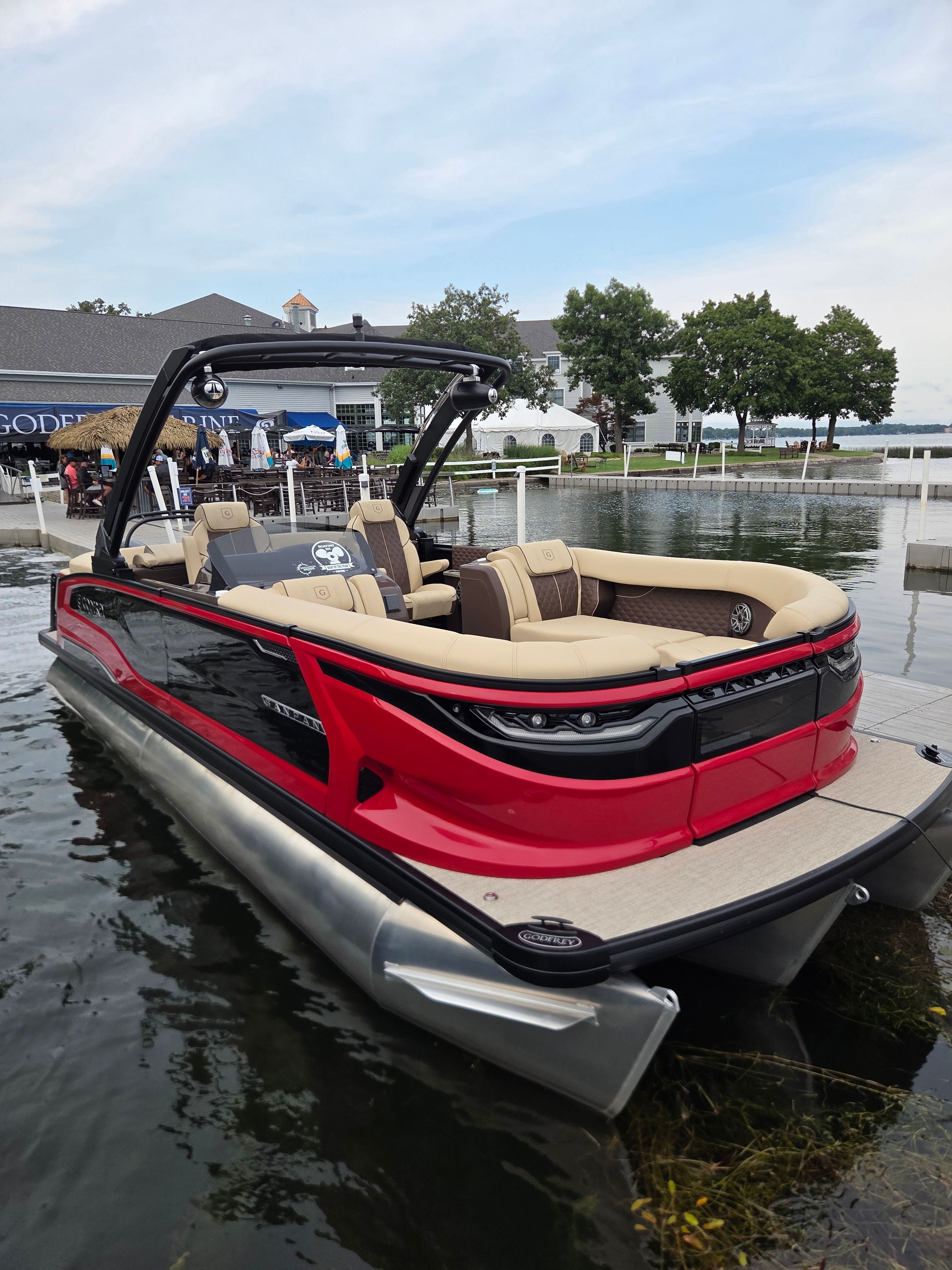
If you're putting a 200 HP or larger engine on the boat, a tritoon isn't optional — it's necessary to handle the power safely and efficiently. Our Godfrey Monaco and Sanpan series are available as tritoons with performance tube packages that are purpose-built for Lake Lanier's open water.
4. Choosing the Right Engine
The engine is where buyers most often either overspend or underspec. Here's how to think about it:
Honda Marine is our primary engine partner, and for good reason. Honda four-strokes are the quietest, most fuel-efficient outboards on the market. They start every time, require less maintenance than two-strokes, and hold their resale value. For most 22–24 foot pontoons, a Honda BF150 is the perfect match.
For performance buyers, we spec Honda BF200 and BF250 engines on our tritoon packages. These are the engines behind our 52 MPH tritoons — the same boats that routinely outrun center consoles on the lake.
Suzuki and Yamaha are also excellent choices and available on several of our models. All three brands offer comparable reliability; the differences come down to specific model compatibility and personal preference.
One rule of thumb: don't underpower your boat. A 90 HP engine on a 24-foot pontoon will get you around the lake, but you'll feel it every time you try to get on plane with a full load of passengers. Spec at least 115 HP for a 22-footer, and 150+ for anything larger.
5. Features Worth Paying For (And Ones That Aren't)
After years of selling boats, here's our honest take on which upgrades are worth it:
Worth every penny:
- Upgraded flooring — Marine-grade vinyl or composite decking holds up to sun, water, and bare feet far better than carpet. You'll thank yourself in year three.
- Bimini top with full enclosure — Georgia summers are brutal. A full enclosure lets you stay out longer and protects the interior when the boat is stored.
- Stereo system — A quality marine audio system is one of the most-used features on any boat. Don't cheap out here.
- Swim platform with ladder — Non-negotiable if you have kids or plan to swim.
Skip or wait:
- GPS chartplotter — Lake Lanier is well-marked and most buyers navigate fine with a phone mount. Save the money unless you're doing serious fishing.
- Underwater lighting — Beautiful, but rarely used. Add it later if you find yourself doing a lot of evening cruising.
6. New vs. Used: What the Numbers Actually Say
A common question we hear: "Should I buy new or used to save money?"
The honest answer is that new pontoons hold their value better than almost any other boat category, especially Godfrey and Veranda models. A well-maintained three-year-old pontoon often sells for 80–85% of its original price. That means the "savings" on a used boat are smaller than buyers expect, and you're inheriting someone else's maintenance history.
That said, a certified pre-owned pontoon from a reputable dealer — with a full inspection and warranty — can be a smart buy. The key word is certified. A private-sale used boat with no service records is a gamble.
New boats also come with manufacturer warranties (Godfrey offers a limited lifetime structural warranty on their pontoon logs), current safety equipment, and the ability to customize colors, upholstery, and options to your exact preferences.
7. What to Expect at Our Dealership
When you visit us at Lake Lanier or Lake Norman, here's what the buying process looks like:
Step 1: Walk the lot. We'll show you what's in stock and let you sit in boats, compare layouts, and get a feel for different sizes. No pressure, no scripts.
Step 2: Talk numbers. We'll walk through pricing, current factory incentives, and financing options. We work with multiple lenders and can usually get approvals within 24 hours.
Step 3: Sea trial. For any boat you're seriously considering, we'll take it on the water. You should never buy a boat you haven't driven.
Step 4: Delivery and orientation. When you take delivery, we spend time on the water with you — covering controls, safety equipment, docking techniques, and maintenance basics. We want you confident, not just excited.
Ready to Start Shopping?
The best pontoon boat is the one that fits how your family actually lives on the water. Come see us at Lake Lanier in Gainesville, GA or Lake Norman in Mooresville, NC — we'll help you find it.
Browse our current Lake Lanier inventory or Lake Norman inventory, or contact us with any questions. Our team is on the water every week and happy to give you an honest recommendation.
Explore Topics
Written by
Carefree Boat Sales Team
Content creator and writer sharing insights and stories.