Real-World Pontoon Performance Testing: The Numbers Speak for Themselves
Carefree Boat Sales owner David Rothwell put 16 Premier pontoons on Lake Lanier with all four engine brands to answer the questions customers actually ask. Here is what the data showed.
How fast does a pontoon actually go with a full load of people on board? What happens to your top speed when you add 1,200 pounds — or 2,400 pounds — of passengers, gear, and a cooler? Which engine brand really wins when the conditions are real?
These are the questions customers ask us every day at Carefree Boat Sales. And back in December 2020, our owner David Rothwell decided to stop guessing and start testing.
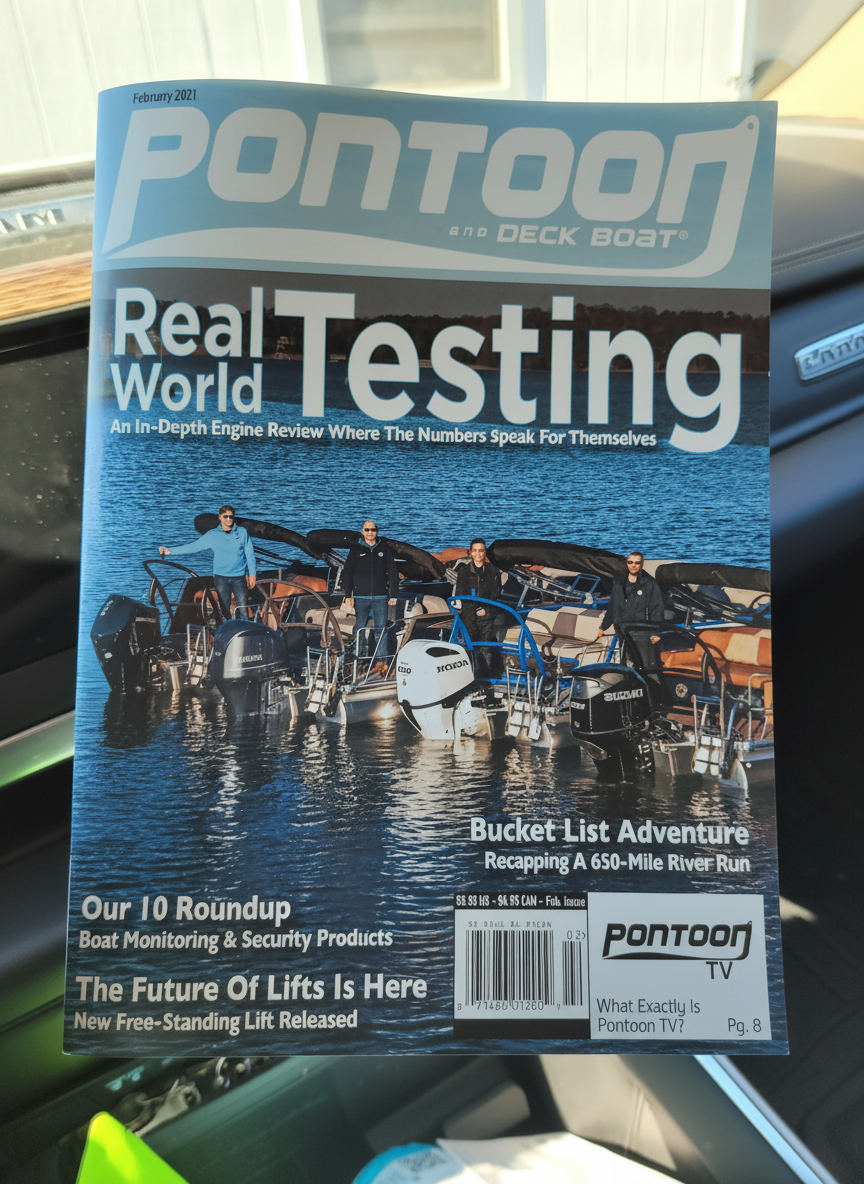
The result was one of the most comprehensive real-world pontoon performance tests ever conducted — covered in the February 2021 issue of Pontoon & Deck Boat Magazine — and the data it produced still shapes how we advise every customer who walks through our door.
Why We Did This Test
Most published boat performance data is collected under ideal conditions: two people in the boat, Bimini top in the trailering position, a quarter tank of fuel, and a prop geared for maximum speed. That data has its place, but it does not answer the question our customers are actually asking.
"We never see our boat club members going out for the day with just two people," explained Rothwell. "There are eight or more on board, a cooler, a tube, and most of the time they even have the family dog. We see boats come and go every day and they're packed — so that's how we wanted to do our testing."
Rothwell had a boat show's worth of Premier pontoons in the water on Lake Lanier — 16 boats total, with seven identical models representing all four major engine brands: Honda, Mercury, Suzuki, and Yamaha. Engine technicians from all four manufacturers were on site to ensure the best possible numbers. Propeller support came from Solas. Premier Marine's CEO Rick Gallagher flew in with his full team to support the event.
"We had 16 boats on the water and it was great to have each of the engine manufacturers represented here and their willingness to be a part of this," said Gallagher. "Given the way horsepower is going and the performance we see in our boats, we wanted to showcase what these engines can really do."

The Test Setup: Identical Boats, Four Engine Brands
The key to making this test meaningful was controlling the variables. Every boat in the comparison was an identical Premier pontoon — same hull, same length, same configuration. The only variable was the engine.
"When looking at data comparisons online, the boat brands are always different, the engines are different, and the props are different," said Rothwell. "We wanted to hold our own test with identical boats where we're only changing the motor and finding the best real-world prop."
Testing was conducted at three load levels:
- Baseline: Two people — the standard "magazine test" condition
- Half load: Six adults, approximately 1,200 pounds
- Full load: Twelve adults, approximately 2,400 pounds
The 250 HP and 300 HP configurations from all four brands were tested side by side. The results were eye-opening.
Top Speed: The Gap Is Smaller Than You Think
At baseline (two people), all four engine brands at both 250 HP and 300 HP were capable of reaching 40 MPH. The gap from the fastest to the slowest across all eight configurations was just 4.7 MPH — a surprisingly tight spread.
"To go from fast to fastest is typically around $7,500 or more at a retail price," Rothwell noted. "When the boats have 1,200 pounds or six average adults on board, all the speeds dropped around 3 mph above 5,500 RPM. That is where the extra weight impacts speed. With a full load at 2,400 pounds or around 12 adults, the average speed fell to around 9 mph."
That last number is the one that matters most. No single-engine boat in the test could reach 40 MPH with a full passenger load. The twin-engine boats maintained that capability — but at a significant cost premium and higher fuel burn.
The Mercury 300 HP was the top speed leader among the 300 HP single-engine boats at baseline and half-load. But the story changed dramatically under full load.
The Suzuki Duo Prop Advantage Under Load
The biggest surprise of the test was the Suzuki Duo Prop technology under heavy load conditions.
"We saw a clear advantage with the Suzuki Duo Prop Technology as we added weight," said Rothwell. "The extra grip of the props made a big difference in performance, and this is something to consider if you go out often with a lot of friends and family."
While the Mercury 300 led at lighter loads, the Suzuki Duo Prop configurations came out on top when the boats were fully loaded. The counter-rotating dual propellers provide significantly more grip and traction in the water — an advantage that becomes most apparent when the boat is heavy and the engine is working hardest.
"The Mercury 300 was the top speed king for all the 300 HP boats with a baseline load and with a capacity of 1,200 pounds, but when we went to a full passenger load the Duo Props came out on top."

Acceleration: Yamaha Leads, Suzuki Surprises
Yamaha was the clear winner in acceleration at baseline — the fastest 0-to-20 and 0-to-30 times of any engine in the test. The remaining brands were all within 0.2 seconds of each other at baseline, which in real-world terms is imperceptible.
As weight increased, the story changed:
- At 1,200 pounds (6 adults): 0-to-20 times dropped by an average of 0.4 seconds across all brands — about 12 percent slower. Noticeable, but not dramatic.
- At 2,400 pounds (12 adults): 0-to-20 times dropped by an average of 1.5 seconds — roughly 40 percent slower. This is where the differences between engines became most visible.
"When comparing the 0-to-30 times, the extra weight really added to the times and leveled the playing field," noted Rothwell. "Times dropped by 1.2 seconds for the 1,200-pound test and 4.4 seconds for the 2,400-pound test on average. The surprise star of this test was the new Suzuki 300 DP. It was the 'heavyweight champ.'"
Worth noting: the Honda 250 and Mercury 250 both had strong showings throughout the test, consistently competitive with the larger 300 HP motors. For buyers looking to save money without sacrificing real-world performance, both are excellent choices.
Fuel Economy: Honda Wins on Efficiency
Honda's reputation for fuel efficiency held up under testing. The BF250 and BF300 consistently delivered the best fuel economy numbers across all load conditions — a meaningful advantage for buyers who plan to spend full days on the water.
The Suzuki Duo Prop's performance advantage came with a fuel cost. "The speed and performance we saw with the Suzuki Duo Props came at a cost of fuel economy, since going fast isn't cheap," stated Rothwell.
The fuel numbers across all engines at wide-open throttle were significant: going from 5,000 RPM to WOT produced an average speed gain of about 8.5 MPH — but fuel consumption jumped by the same amount in gallons per hour, from roughly 13–18 GPH to 22–28 GPH.
Fuel grade requirements also vary by engine:
- Honda: 87 octane regular
- Mercury (all configs): 89 octane
- Suzuki 300 HP: 89 octane
- Suzuki 350 HP DP: Premium fuel required
- Yamaha: Premium fuel required
For buyers who plan to run hard and often, Honda's combination of strong performance and regular-fuel efficiency adds up to real savings over the life of the boat.
The Barrel Race: Real-World Handling Under Pressure
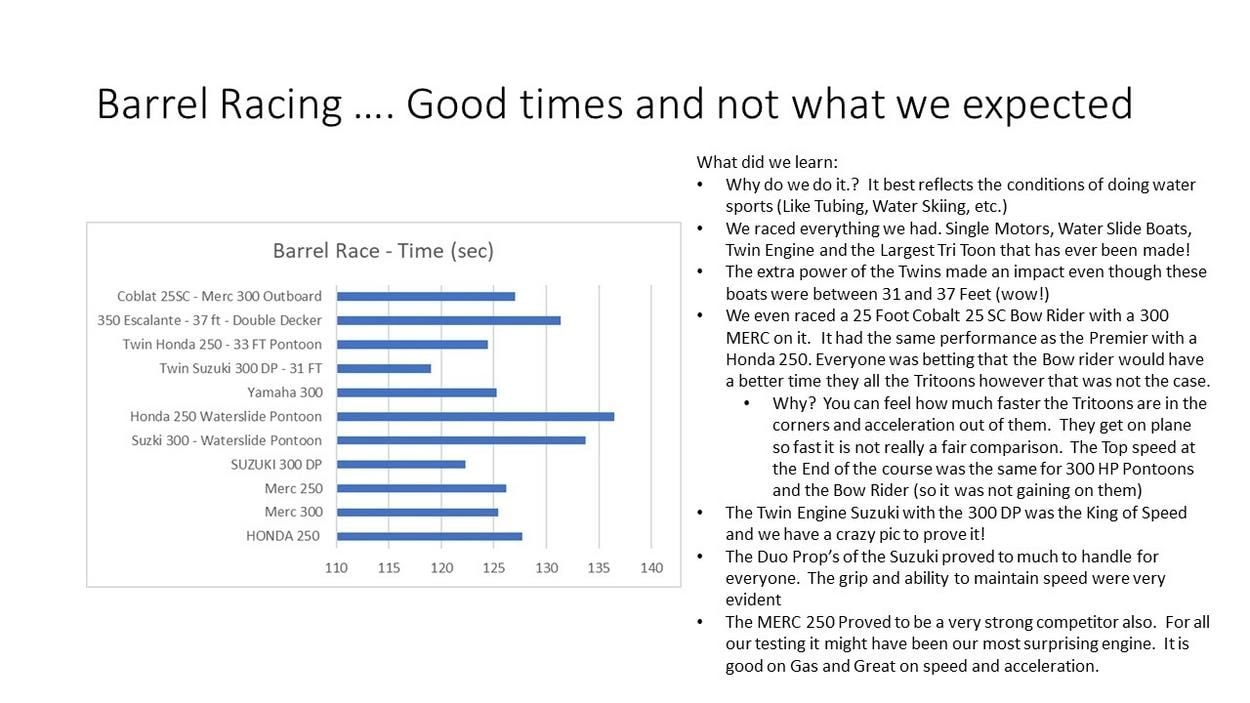
To test real-world handling — the kind of conditions you encounter towing a tube or navigating a busy Saturday on Lake Lanier — the team set up a barrel race course with sharp turns, zigzags, and a straight WOT run to the finish.
Rothwell drove every boat himself for consistency, with each boat making multiple passes and the best three averaged.
"Everyone was betting the Bow Rider would have a better time than the pontoons; however, that was not the case," said Rothwell. A 25-foot Cobalt 25 SC with a Mercury 300 matched the performance of a Premier pontoon with Honda 250 HP — a result that surprised nearly everyone watching.
The twin-engine Suzuki with 300 HP Duo Prop outboards won the barrel race outright. "The Duo Prop's on the Suzukis proved to be too much to handle for everyone. The grip and ability to maintain speed were very evident."
What the Prop Testing Revealed
Solas Propellers account manager Vladimir Kolbasov was on site with the engine manufacturer reps, and the team tried a wide variety of prop configurations on every boat. Key findings:
- No four-blade prop outperformed a traditional three-blade in any configuration tested
- Diameter matters more than pitch on larger pontoons — going from 15" to 15.5" to 16" diameter made a bigger difference than pitch changes
- Solas aftermarket props matched or beat OEM props in most configurations, at significantly lower cost
- For Suzuki single-prop motors: A 16" diameter prop is essentially mandatory — nothing else worked well
- For Honda: Larger cup, larger diameter props around 16–17 pitch performed best
- For Yamaha: Pitch above 15 was counterproductive — the team could not pull the RPM needed with 16 or 17 pitch props
- For Mercury: The team found strong results but noted more work was needed to find the optimal combination
"Across the board the Solas props have the same or better performance at much lower pricing and a wider variety to help dial in the boat," said Rothwell. "Going from 15 to 15.5 to a 16 diameter prop made a huge difference on each boat brand and motor combination."
One additional finding worth noting: raising the motor height produced 1–1.5 MPH speed gains on both Suzuki and Honda configurations. However, Rothwell recommends standard height for buyers who do a lot of watersports, since the lower position provides better traction and less blowout in corners under load.
The Real-World Takeaway
The most important finding from the entire test was the last one — what happened when all 12 adults climbed aboard.
"We had already done the comparison earlier with six adults and all the baseline testing with two people, and to see how the performance dramatically changed across each motor differently than expected was probably our biggest takeaway under real-world conditions," concluded Rothwell. "It's dramatic how much differently the engines perform compared to when there are just two people on the boat."
The practical implications for Lake Lanier buyers:
- All four engine brands are competitive. The gap between them is smaller than marketing suggests. Choose based on how you actually use the boat — load, watersports frequency, fuel budget.
- If you regularly run with a full boat, consider twin engines or Suzuki Duo Prop. Single-engine performance drops significantly at full load.
- Prop selection matters as much as engine brand. The right prop for your load and use case can make a bigger difference than spending more on a higher-horsepower engine.
- Honda wins on fuel economy. If you run a lot of hours, the fuel savings are real and compound over time.
- Ignore top-speed numbers from two-person tests. They do not reflect how you will actually use the boat.
Come Feel the Difference Yourself
This is exactly the kind of knowledge that separates Carefree Boat Sales from every other dealer near Atlanta. We do not just read the test data — we ran the test. David Rothwell was at the helm for every barrel race run. Our team knows which prop works on which engine under which conditions on Lake Lanier.
When you come to our dealership at Lazy Days Marina in Buford, we will put you on the water in the actual boat you are considering — loaded the way you will actually use it — and let you feel what the numbers mean.
Call us at (678) 725-3749 or stop by the Lake Lanier location. The data does not lie. Come feel it yourself.
Source: Pontoon & Deck Boat Magazine, February 2021 — "Real World Head-To-Head Testing" by Brady L. Kay
Explore Topics
Written by
Carefree Boat Sales Team
Content creator and writer sharing insights and stories.

