Why 350 HP Is Replacing 250 HP on Luxury Tritoons — And Why It's the Right Call
The 250 HP and 300 HP era on high-end tritoons is over. Here is why every major engine manufacturer made the same move at the same time — and what the real-world performance data shows when you put a 350 HP V8 next to what it replaced.
Something has shifted in the tritoon market over the past two seasons, and we are seeing it play out in our showroom every week.
Buyers who bought a 27-foot luxury tritoon with a 250 HP or 300 HP engine three or four years ago are coming back in. Not because anything broke. Not because they are unhappy. They are coming back because they got on a friend's boat with a 350 HP V8, and now their engine feels like a different category of product.
They are right. It is.
What is happening in the market right now is not just a horsepower race. It is a fundamental shift in engine architecture — and once you understand why it happened, the 350 HP move makes complete sense.
The Old Way: Smaller Engines Working Too Hard
For years, getting to 300 or 350 horsepower meant pushing smaller engine blocks to their limits. Mercury's previous-generation L6 Verado, for example, used a supercharger to force-feed air into a smaller displacement block to hit its horsepower numbers. It worked. But it worked hard.
The problem with that approach on a heavy, drag-heavy tritoon platform is physics. A 27-foot tritoon loaded with 10 adults, a cooler, and gear can weigh close to 7,000 pounds on the water. A smaller-displacement engine hitting 300 HP at the top of its rev range is working at or near its limit just to keep that weight moving at 45 MPH. You hear it. You feel it. And over time, you pay for it in service intervals and longevity.
The 250 HP engines were not bad engines. They were just being asked to do a job they were not sized for.
What Changed: The Big-Block Revolution
Mercury made the move first and made it loudly. They retired the supercharged inline-6 Verado platform entirely and replaced it with a naturally aspirated 5.7-liter V10 — the new Verado 350 and 400. No supercharger. No forced induction. Just massive displacement doing the work that displacement is supposed to do.
Honda Marine followed with the BF350 V8 — a 5.0-liter block with Honda's VTEC variable valve timing, the same technology Honda uses in its performance car engines. Yamaha brought the F350 V8 at 4.2 liters. Suzuki has the DF350A with a dual-prop counter-rotating setup.
Every major manufacturer landed on the same conclusion at roughly the same time: the right way to make 350 HP for a heavy tritoon is with displacement, not with a smaller engine working at its ceiling.
The result is an engine that makes its power low in the RPM range — the same way a diesel truck makes torque — rather than at the top of its rev range. That matters enormously on a loaded tritoon.
Why Bigger Displacement Changes the On-Water Experience
Here is the part that surprises buyers who have not driven both back to back.
When you load a 27-foot tritoon with a full group and bury the throttle on a 250 HP engine, the boat labors onto plane. The engine is screaming. The bow is high. It takes a few seconds to get the hull up and moving. Once you are there, you are running the engine hard to maintain speed.
Put a 350 HP V8 on the same boat with the same load, and the experience is completely different. The engine barely raises its voice. The boat comes onto plane quickly and confidently. At cruise speed — say 30 to 35 MPH — the engine is turning 3,500 to 4,000 RPM and has significant power in reserve. It is not working. It is loafing.
That difference is not just about comfort. It is about fuel efficiency, engine longevity, and the overall ownership experience over five years.
The Counterintuitive Fuel Story
This is the part that surprises people most: a 350 HP V8 can actually use less fuel than a 250 HP engine on the same tritoon.
The reason is simple. A 250 HP engine on a heavy tritoon has to run near wide-open throttle to maintain plane and speed. A 350 HP V8 on the same boat reaches cruise speed at a fraction of its capacity and then throttles back. Honda's BF350 uses VTEC and lean-burn technology specifically to optimize fuel consumption at mid-range RPMs — the range where tritoon owners actually spend most of their time.
The math works out. We have seen it in our own customer data and in published manufacturer testing. An underpowered engine running hard burns more fuel than a properly sized engine running easy.
The Resale Argument Is Real
There is a practical financial reason to pay attention to this shift, and it matters if you are buying a boat today.
As premium tritoons from Godfrey, Barletta, and Bennington crossed the $100,000 to $150,000 price point, the market's expectations for what engine belongs on those boats changed with them. A 250 HP engine on a 27-foot premium tritoon is now widely considered underpowering the hull — and it shows up in trade-in values.
Buyers shopping the used market know what to look for. A 350 HP V8 on a 2024 or 2025 tritoon holds its value. A 250 HP on the same hull takes a discount. If you are financing a boat at today's rates, that depreciation gap matters at the five-year mark.
What We Are Seeing at Lake Lanier
We have been selling and servicing tritoons at Lake Lanier for years, and the shift in what buyers are asking for has been dramatic in 2026.
Two seasons ago, a 250 HP engine was a reasonable choice on a 25-foot tritoon. Today, buyers who come in seriously shopping a 27-foot platform almost universally want 350 HP. The ones who do not start there usually get there after a water demo — once they feel the difference, the conversation changes.
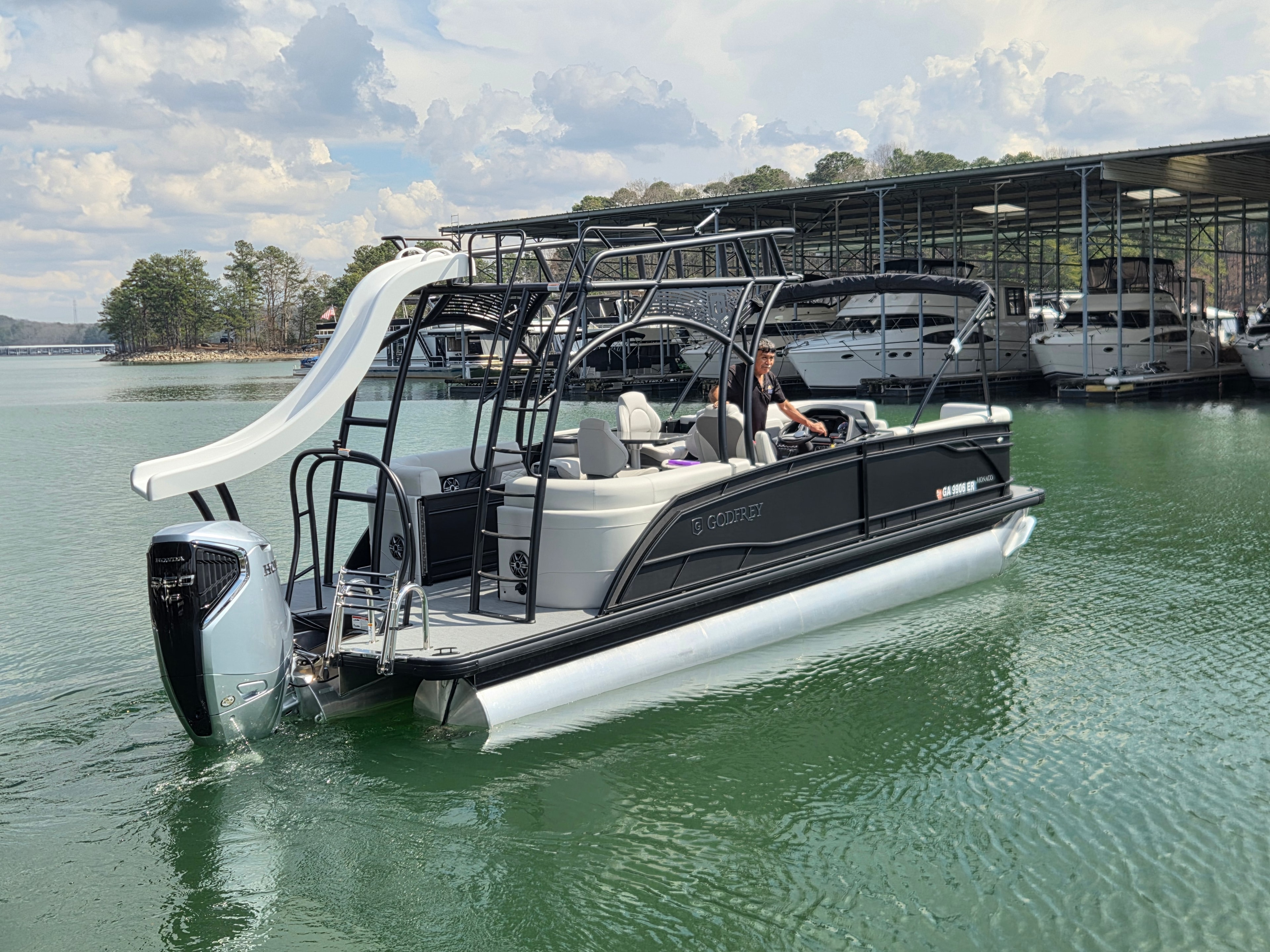
The engine we are selling most on the Godfrey Monaco platform is the Honda BF350. It is the engine that produced 52.2 MPH in independent testing on a comparable tritoon — the highest documented top speed of any 350 HP outboard tested on a pontoon platform, as confirmed by Pontoon & Deck Boat Magazine. And it does it while being the most fuel-efficient option in the class.
The Performance Data: 250 HP vs. 350 HP on a 27-Foot Tritoon
This is what the numbers actually look like when you put both engine classes on a comparable platform under real-world conditions.
Top Speed Comparison — 350 HP Class (Independent Test Data)
| Engine | Displacement | Configuration | Top Speed (27' tritoon) |
|---|---|---|---|
| Honda BF350 | 5.0L | V8 naturally aspirated | 52.2 mph |
| Yamaha F350 | 4.2L | V8 naturally aspirated | 49.5 mph |
| Mercury Verado V10 350 | 5.7L | V10 naturally aspirated | 49.0 mph |
| Suzuki DF350A | 4.4L | V6 dual-prop | 44.3 mph |
Source: Independent performance testing on comparable tritoon platforms. Honda result from Tahoe 2585 Cascade test. See our full breakdown in Honda BF350 vs. Yamaha, Mercury & Suzuki: Real 350 HP Test Data.
Fuel Efficiency Comparison — Honda BF350 vs. 250 HP Class (27' Tritoon, 2 Passengers)
| Speed | Honda BF350 (350 HP) | Typical 250 HP Engine | Advantage |
|---|---|---|---|
| 20 MPH cruise | ~5.2 MPG | ~3.8 MPG | +37% better |
| 30 MPH cruise | ~4.8 MPG | ~3.2 MPG | +50% better |
| WOT | ~2.4 MPG | ~2.1 MPG | +14% better |
| Typical RPM at 30 MPH | 3,500–4,000 | 5,200–5,800 | Running easy vs. working hard |
Fuel figures based on published manufacturer data and real-world customer reports. Actual results vary with load, trim, hull design, and conditions. 250 HP figures represent typical published data for comparable V6 outboard platforms at similar speeds.
Engine Architecture: Old Era vs. New Era
| Old Era (250–300 HP) | New Era (350 HP V8/V10) | |
|---|---|---|
| Displacement | 2.6–3.3L | 4.2–5.7L |
| Configuration | V6, some supercharged | V8 or V10, naturally aspirated |
| Peak power RPM | 5,500–6,000 | 5,000–5,500 |
| Cruise RPM at 30 MPH | 5,000–5,800 | 3,500–4,200 |
| Torque character | High-revving, peaky | Flat, broad, automotive |
| Heavy-load behavior | Labors, bogs | Effortless, in reserve |
| Typical warranty | 3 years | 5 years (Honda BF350) |
The Bottom Line
The 350 HP move is not a marketing trend. It is the right engine for the boat.
A 27-foot luxury tritoon is a heavy, drag-heavy platform. It deserves an engine with the displacement to move it effortlessly — not an engine working at its ceiling to keep up. The V8 and V10 platforms from Honda, Mercury, and Yamaha deliver that. The fuel numbers are better. The ownership experience is better. The resale story is better.
If you are shopping a premium tritoon right now and considering a 250 HP to save money on the front end, run the five-year math first. The fuel savings alone on the Honda BF350 can offset a significant portion of the price difference — and you will be driving a boat that feels like it was built for the engine, not one that is working too hard to keep up.
Come see us at Lake Lanier. We will put you on the water with both and let you decide.
Call us at (678) 725-3749 or browse our current Godfrey Monaco inventory to see what is in stock with the Honda BF350 right now.
Explore Topics
Written by
Carefree Boat Sales Team
Content creator and writer sharing insights and stories.