The Displacement Shift: Why 350 HP V8 and V10 Outboards Are Replacing the 250s on Luxury Tritoons
Go to any major dock on the lake right now and you will notice a massive shift on the backs of premium tritoons. The supercharged inline-6s and smaller-displacement 250 HP and 300 HP outboards are rapidly disappearing. Here is why large-displacement V8 and V10 blocks have become the new baseline standard — and why the physics make it inevitable.

Go to any major dock on the lake right now, and you will notice a massive shift happening on the backs of premium tritoons. The supercharged inline-6s and smaller-displacement 250 HP and 300 HP outboards that dominated the last five years are rapidly disappearing. In their place is a new king of the water: the large-displacement 350 horsepower platform.
At Carefree Boat Sales, we have been tracking this engine evolution closely. The shift toward modern V8 and V10 blocks is not just a quest for raw top-end speed — it is a fundamental change in marine architecture driven by weight, torque, and real-world efficiency.
Here is why the 350 HP class has become the absolute baseline standard for luxury tri-tubes.
Displacement Wins the Heavy-Load Battle
Tritoons are inherently high-drag, high-capacity vessels. When you load up a 25-to-27-foot boat with 12 adults, coolers, and full gear, a smaller-displacement 250 HP engine has to work incredibly hard. Older engine architectures often relied on superchargers or high RPMs to "force" horsepower out of a smaller block.
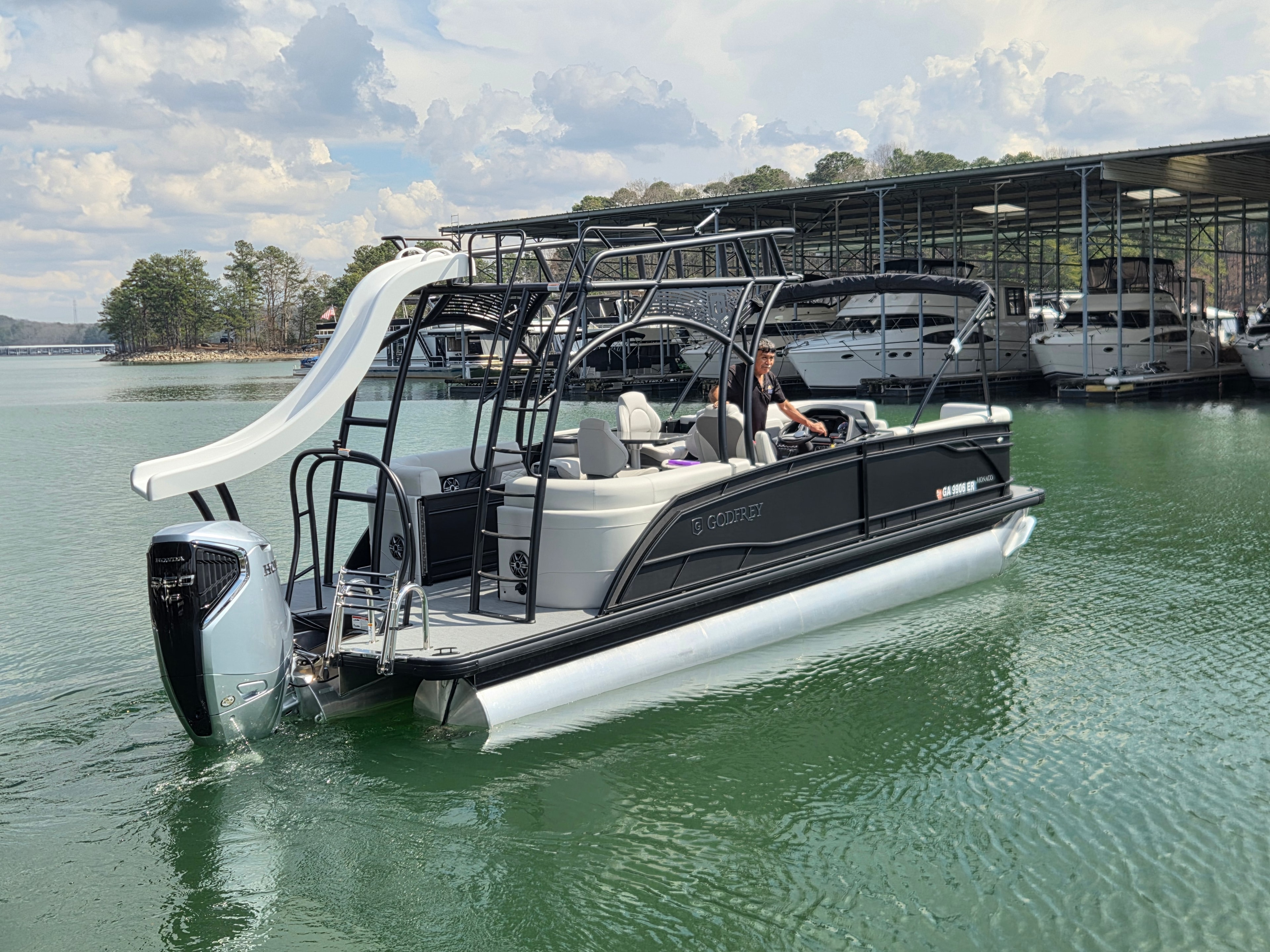
The new era belongs to raw, natural displacement. Engines like the Honda Marine BF350 V8 — a massive 5.0-liter powerhouse — and the Mercury 5.7L V10 Verado offer brutal, low-end automotive torque. They swing larger, heavy-duty propellers that grab the water instantly. Instead of lagging, a 350 HP block pops a heavily loaded tritoon onto plane effortlessly, keeping the engine running in its comfortable, quiet mid-range.
The physics are simple: a larger displacement engine produces more torque at lower RPMs. More torque at lower RPMs means less strain on the drivetrain, less heat, less vibration, and a dramatically smoother experience for everyone on board — especially at the speeds where families actually spend their time on the water.
How the Major Platforms Compare
| Engine | Displacement | Configuration | Top Speed (Godfrey Monaco) | Cruise RPM |
|---|---|---|---|---|
| Honda BF350 V8 | 5.0L | Naturally aspirated V8 | 52.2 MPH | ~3,500 RPM |
| Yamaha F350 V8 | 5.6L | Naturally aspirated V8 | 49.5 MPH | ~3,800 RPM |
| Mercury V10 Verado | 5.7L | Supercharged V10 | 49.0 MPH | ~3,600 RPM |
| Suzuki DF350A | 4.4L | Supercharged V6 | 44.3 MPH | ~4,000 RPM |
Speed data from Carefree Boat Sales Lake Lanier prop testing. All engines tested on a Godfrey Monaco tritoon with equivalent load.
The Honda BF350 V8 leads the class in top speed on a Godfrey Monaco — not because it has the largest displacement, but because its naturally aspirated architecture delivers power more linearly and efficiently than the supercharged alternatives. No boost lag. No supercharger whine. Just clean, progressive power from idle to wide-open throttle.
The Fuel Efficiency Paradox
It sounds entirely counterintuitive to tell a customer that a larger engine will save them money at the fuel dock — but the telemetry proves it.
When a tritoon is underpowered with a 250, the driver is forced to bury the throttle at 80% to 90% wide-open capacity just to maintain a decent cruise against the wind and chop. A large-displacement V8 or V10 cruises at those exact same speeds at a lazy 3,500 RPMs.
By leveraging advanced technology like Honda's VTEC (Variable Valve Timing) and lean-burn electronic fuel control, these massive engines optimize the fuel-to-air ratio at cruise speeds — often outperforming smaller engines that are screaming at high RPMs just to keep up. The result: you are burning less fuel per mile at cruise, with a quieter, smoother ride, and far less wear on the engine over its lifetime.
The 250 HP engine working at 85% capacity is not just louder and rougher — it is also burning more fuel per mile than the 350 HP engine loafing along at 55% capacity. The larger engine wins on efficiency precisely because it is never working hard.
Why the 250 HP Era Is Ending
The market has spoken clearly. Here is what is driving the transition:
Premium buyers expect premium performance. A $90,000-plus tritoon paired with a 250 HP engine is increasingly seen as a mismatch. The boat's capability exceeds the engine's ability to deliver it. Buyers who spend at this level expect the full experience — and the full experience requires 350 HP.
Tri-tube platforms keep getting heavier. Modern luxury tritoons are loaded with features: hardtops, premium audio, full wet bars, extended swim platforms, and high-end upholstery packages. Every one of those features adds weight. A 250 HP engine that was adequate on a stripped-down 2019 model is noticeably underpowered on a fully loaded 2027 build.
The price gap has closed. Three years ago, stepping from a 250 HP to a 350 HP package added $15,000 to $20,000 to the purchase price. Today, at Carefree Boat Sales, we are pairing the Godfrey Monaco with the Honda BF350 V8 starting at $79,995 — a price point that was unthinkable for a V8-powered luxury tritoon just two years ago.
Protecting Your Long-Term Resale Value
As luxury tritoons from top-tier builders like Godfrey cross into premium price brackets, buyers demand an uncompromised experience. A large-platform tri-tube paired with anything less than a 350 HP is quickly becoming recognized on the secondary market as "underpowered."
When you go to sell a 2027 tritoon in three or four years, the first question a serious buyer will ask is: "What engine?" A Honda BF350 V8 or Mercury V10 Verado is a conversation-starter. A 250 HP inline-6 is a negotiating chip — used against you.
Choosing the V8 or V10 platform ensures your boat retains peak desirability and maximum resale value down the road. The engine is not just a performance decision. It is a financial one.
The Honda BF350 V8 Advantage at Carefree
We do not just sell these packages out of a catalog — we custom-build them to disrupt the market. Right now, we are pairing the award-winning Godfrey Monaco tritoon with the Honda BF350 V8 starting at an unbelievable $79,995.
That gives you a premium, 52-MPH, V8-powered luxury cruiser for less than what most corporate dealers are charging for a standard 200 HP pontoon. The same boat with a Mercury or Yamaha 350 costs $8,000 to $15,000 more — and goes slower.
Why does Honda win on price? Because we are Georgia's #1 Honda BF350 Dealer for 2024, 2025, and 2026. Volume pricing flows directly to our customers.
Schedule Your Side-by-Side Demo
The best way to understand the displacement difference is to feel it. We regularly run back-to-back on-water demos at Lan Mar Marina and Lazy Days Marina on Lake Lanier — same boat, different engines, same conditions.
Call us at (678) 725-3749 to schedule your demo, or explore the Godfrey Monaco lineup to see current models and pricing.
Related reading:
Explore Topics
Written by
Carefree Boat Sales Team
Content creator and writer sharing insights and stories.