The Monterey Elite's Flat Front: European Design Meets American Comfort
That bold vertical bow on the Monterey Elite isn't just a style statement — it's borrowed from the world's best offshore adventure boats. Here's what it means for your ride on Lake Lanier.
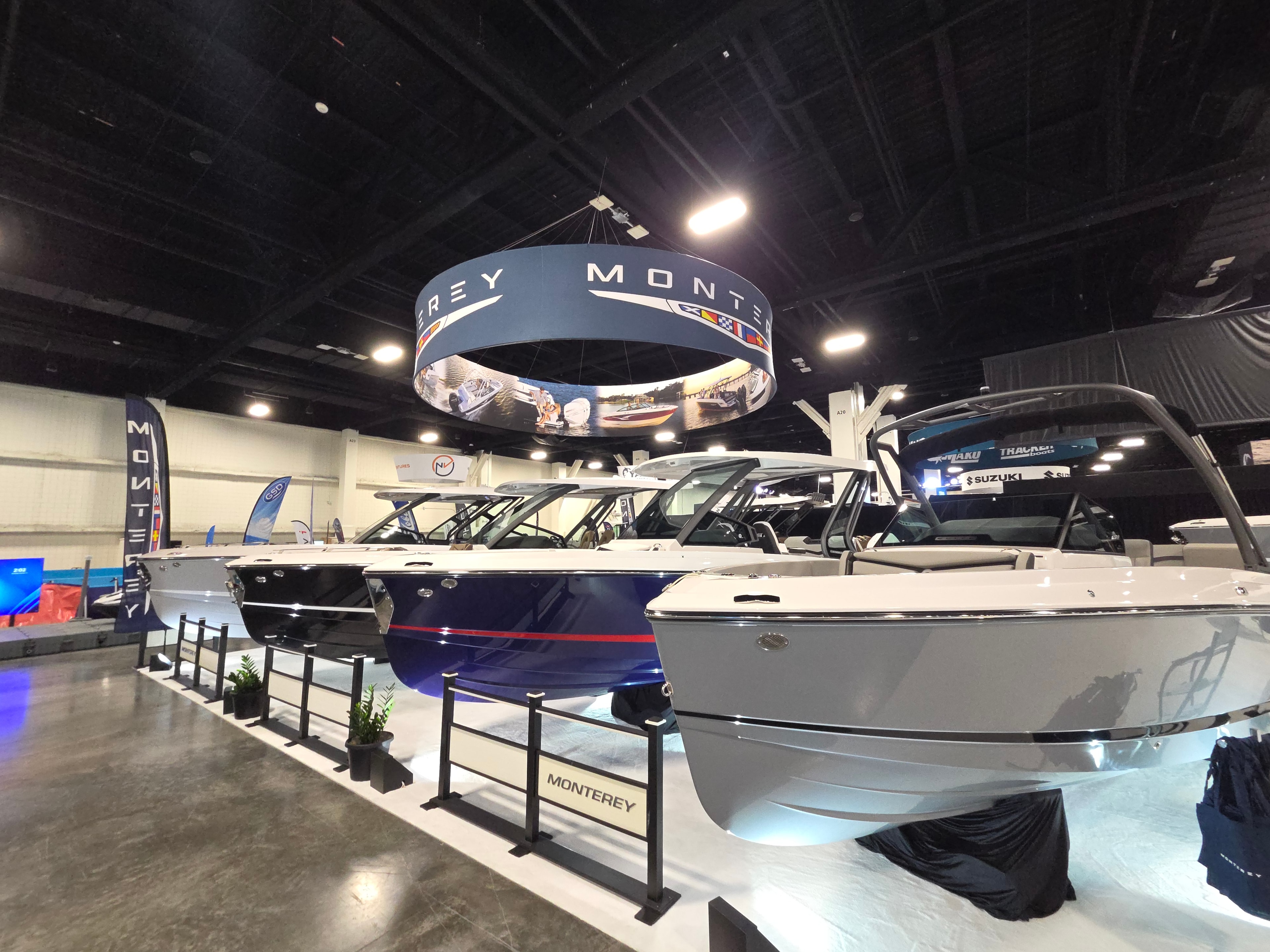
The first thing buyers notice when they walk up to a Monterey Elite is the bow. It doesn't look like any American sport boat they've seen before. It's blunt. It's vertical. It's almost aggressive in the way it presents itself — more like a military tender or a high-end European commuter boat than anything that's come out of a domestic manufacturer.
That reaction is exactly what Monterey intended. And once you understand why that bow is shaped the way it is, you'll understand why the Elite rides the way it does — and why buyers who've spent time on Lake Lanier's afternoon chop are paying close attention.
What Is the "Flat Front" — and Where Did It Come From?
The technical term is a Vertical Stem (VST) or plumb bow. Instead of the traditional raked bow that sweeps back at an angle — the classic American sport boat look — the VST bow rises nearly straight up from the waterline.
This design was pioneered in the mainstream recreational market by European builders, most notably Axopar (Finland), Nimbus (Sweden), and Jeanneau/Beneteau (France). If you've ever seen an Axopar 37 or a Nimbus T11 in person, the family resemblance to the Monterey Elite is immediately obvious. The square stem, the low-slung profile, the center-console helm feel — it's the same design language.
In Europe, this style is called the "adventure boat" or "crossover" category. It's been dominant in Scandinavian and coastal European markets for over a decade. What Monterey did was take that hull philosophy and bring it to the American lake and coastal market — with a distinctly American interior.
The Engineering Behind the Look
This isn't just aesthetics. The VST bow delivers real, measurable performance advantages that matter on a lake like Lanier.
More Running Surface Without More Length
Here's the engineering insight that most buyers don't realize: the vertical stem bow extends the hull's running surface by 3 to 5 feet without adding to the boat's overall trailerable length.
On a traditional raked bow, a significant portion of the hull forward of the waterline is angled upward and out of the water — it's essentially dead length. The VST bow pushes the hull's effective running surface all the way to the very tip of the bow. The result is that an Elite 30 rides and handles with the stability and planted feel of a traditional 35-foot boat, while still trailering at 30 feet.
For buyers on Lake Lanier, where trailering to and from the ramp is part of the routine, that's a meaningful advantage.
It Slices Chop Instead of Riding Over It
Anyone who's been on Lake Lanier on a Saturday afternoon in July knows what wind chop looks like. By 2 PM, you can have 2-foot rollers coming across the main channel, and a traditional bow rider will pound through them — bow rising, slamming down, spray everywhere.
The VST bow, combined with the Elite's deep 21° deadrise, cuts through chop rather than riding over it. The bow doesn't rise on acceleration the way a traditional hull does. It stays planted, the hull slices the wave rather than climbing it, and the ride stays controlled even when conditions deteriorate.
Testers who've run the Elite in rough water consistently describe it as feeling like a much larger boat than its length suggests. That's the VST hull doing exactly what it was designed to do. Pontoon & Deck Boat Magazine documented this in their independent test of the Elite 34 GT — read our breakdown of those results in PDB Magazine Tests the Elite 34 GT.
Planes Earlier, Runs More Efficiently
The extended running surface also means the Elite reaches plane at lower speeds and with less engine effort than a comparable traditional hull. Less bow rise on acceleration means the hull transitions to plane faster, which translates to better fuel efficiency at cruise speeds and a more comfortable experience for everyone on board during that transition.
Where Monterey Diverges from the European Originals
The Axopar and Nimbus comparison is accurate on the hull and profile, but Monterey made a deliberate choice to diverge from the European formula in one critical area: the interior.
European adventure boats tend to be utilitarian. Clean lines, minimal cushioning, functional layouts designed for offshore passage-making or coastal cruising. They're built for performance and durability, not for spending a Saturday afternoon at a sandbar with eight people and a cooler full of drinks.
Monterey took the European hull and wrapped it in a thoroughly American interior. Deep-cushion bow seating. Convertible L-shaped lounges. High-end upholstery. Social layouts designed specifically for lake entertaining. The glass cockpit helm with a 14- or 15-inch Simrad Ultra-Wide MFD is pure European influence — clean, automotive-grade, almost no physical buttons. But the seating, the layout, the way the boat is configured for a day on the water with family and friends — that's American through and through.
The result is what buyers and reviewers are calling a "best of both worlds" hybrid: the offshore capability and rough-water hull of a European adventure boat, combined with the comfort and social layout of a premium American day boat. If you're coming from a tritoon background, we cover exactly why this matters in Why Bow Rider Fans Are Choosing Monterey Elite Over Tritoons.
The Hardtop: Another European Signature
One more design element worth understanding: the hardtop mounting system on the Elite is directly borrowed from European commuter boat engineering.
Rather than the flexible, bolt-on T-top structures common on American sport boats, Monterey uses a three-point mounting system that anchors the hardtop frame directly into the console edge and gunwales. The result is a top that is completely rattle-free at 50+ mph — something that matters a great deal when you're running across open water at speed.
If you've ever been on a boat with a T-top that vibrates and rattles at anything above 30 mph, you understand why this matters. The Elite's hardtop feels like part of the boat, not an accessory bolted to it.
What This Means for Lake Lanier Buyers
Lake Lanier is a reservoir with a lot of open water, significant afternoon wind chop, and a boating culture that values both performance and family comfort. It's also a lake where you're trailering, which means overall length matters.
The Monterey Elite was built for exactly this kind of water. The VST hull handles Lanier's chop better than any traditional bow rider we've sold. The trailerable length keeps it practical. The interior layout makes it a genuine family boat. And the performance — particularly with Honda's 350 HP V8 — makes it the most exciting sport boat on the lake.
We've been watching buyers walk in asking about tritoons and walk out with an Elite 23 OB after a water demo. The hull feel is that different. The ride is that convincing.
Come See It in Person
We carry the Monterey Elite Series at our Lake Lanier location in Gainesville, Georgia. The 2027 models — which we had on the floor at the Fort Lauderdale International Boat Show — are the best expression of this platform we've seen. New color options, refined layouts, and the same VST hull engineering that's been turning heads since Monterey introduced the Elite line. See the new 2027 colors in our post 2027 Monterey Colors Debut at Fort Lauderdale.
If you want to understand what the flat front actually feels like at speed on Lake Lanier, come out for a water demo. There's no better way to experience the difference between a hull that slices through chop and one that pounds through it.
Call us or stop by the Gainesville location. We'll put you on the water.
Explore Topics
Written by
Carefree Boat Sales Team
Content creator and writer sharing insights and stories.