Why Bow Rider Fans Are Choosing Monterey Elite Over Tritoons
Buyers who traded their bow riders for tritoons are switching again — this time to the Monterey Elite. European hull engineering, American comfort, and a ride that reminds you why you loved boats in the first place.
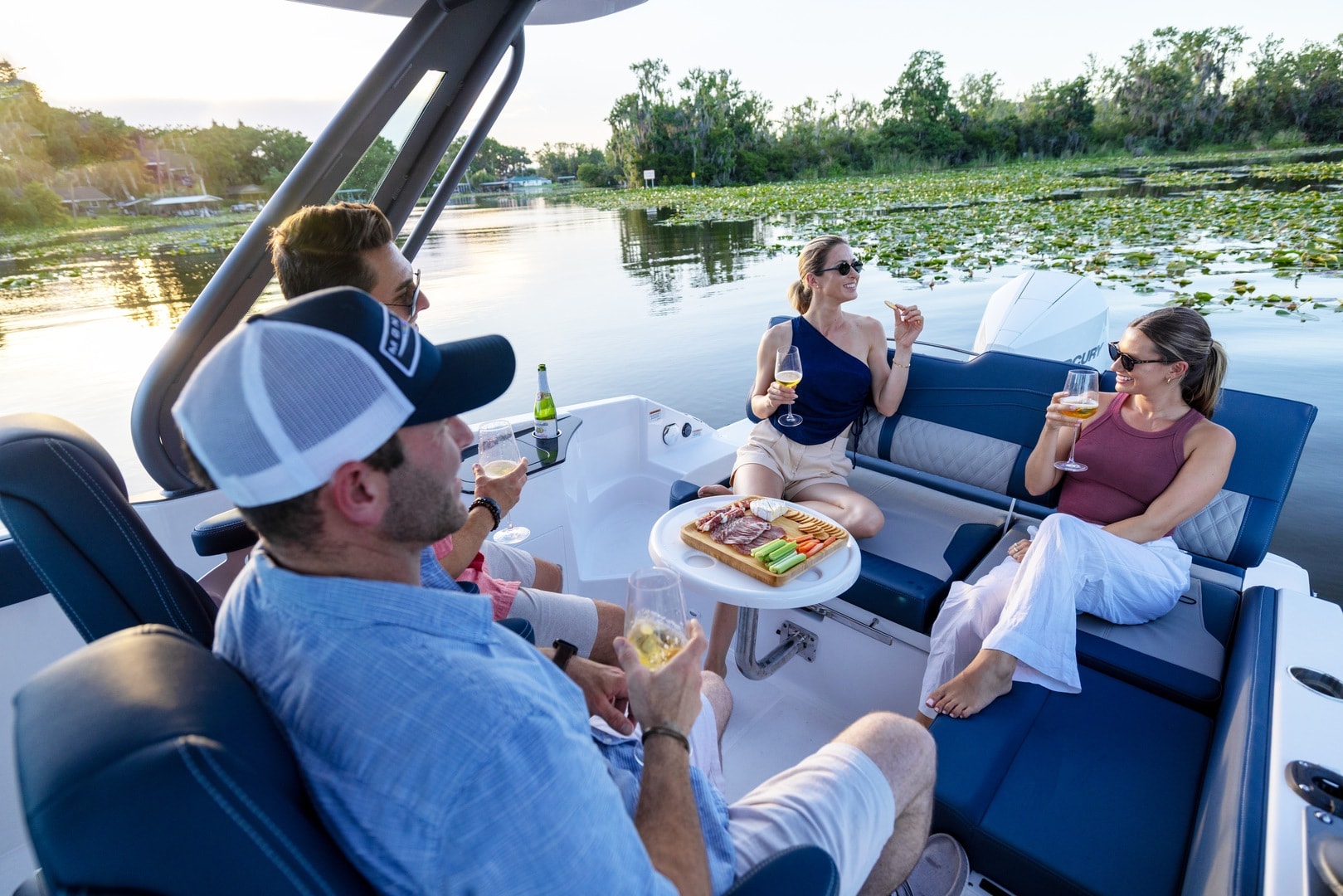
There's a pattern we've been watching unfold at Carefree Boat Sales over the past two seasons, and it's accelerating fast heading into 2027.
Buyers are walking in with a story we've heard dozens of times now: "I had a bow rider for years, loved it. Switched to a tritoon because everyone said it was the smart move. Now I'm ready to go back — but smarter."
The Monterey Elite Series is where that story ends. And it's not a close call.
The Bow Rider to Tritoon Migration — And Why It Stalled
Let's be honest about what happened in the pontoon boom years. Tritoons got genuinely good. They got faster, more comfortable, and more capable. Families who had been running bow riders for years made the switch because the value proposition was hard to argue with — more seating, smoother ride in chop, easier boarding, and a platform that worked for everyone from toddlers to grandparents.
For a lot of buyers, it was the right call. Tritoons earned their place.
But something got lost in the trade. And after a season or two on the water, the buyers who grew up on bow riders started to feel it.
The drive. The connection to the water. The feeling of a hull that responds to you rather than floating over everything. The way a proper sport boat leans into a turn instead of plowing through it.
Tritoons are exceptional family platforms. They are not sport boats. And for a certain buyer — the one who still has that bow rider DNA — that gap eventually becomes impossible to ignore.
What the Monterey Elite Actually Is
The Monterey Elite Series isn't a throwback to the bow riders of the 1990s. It's what a bow rider becomes when you engineer it from scratch with modern materials, modern power, and a design language borrowed from the world's best offshore adventure boats.
The first thing buyers notice when they walk up to an Elite is the bow. It doesn't look like any American sport boat they've seen before. It's blunt. It's vertical. It's almost aggressive — more like a military tender or a high-end European commuter boat than anything that's come out of a domestic manufacturer.
That's intentional. The technical term is a Vertical Stem (VST) or plumb bow, and it was pioneered in the mainstream recreational market by European builders — most notably Axopar (Finland), Nimbus (Sweden), and Jeanneau/Beneteau (France). In Europe, this style is called the "adventure boat" or "crossover" category, and it's been dominant in Scandinavian and coastal markets for over a decade.
What Monterey did was take that hull philosophy and bring it to the American lake market — with a distinctly American interior. The result is what buyers and reviewers are calling a "best of both worlds" hybrid: the offshore capability and rough-water hull of a European adventure boat, combined with the comfort and social layout of a premium American day boat.
The flagship Elite 34 GT is a 37-foot grand touring sport boat with a 10'6" beam, twin outboard capability up to 850 HP, and a starting price of $383,451 fully rigged. The Elite 23 OB brings the same DNA to a more accessible package — 23'7" LOA, 300 HP, 21° deadrise, starting at $90,642. This is the boat converting the most former bow rider owners right now, because the price point is real and the performance is immediate.
The Engineering Behind the Flat Front
This isn't just aesthetics. The VST bow delivers real, measurable performance advantages that matter specifically on a lake like Lanier.
More running surface without more length. The vertical stem bow extends the hull's effective running surface by 3 to 5 feet without adding to the boat's overall trailerable length. On a traditional raked bow, a significant portion of the hull forward of the waterline is angled upward and out of the water — essentially dead length. The VST bow pushes the running surface all the way to the tip. The result: an Elite 30 rides and handles with the stability of a traditional 35-foot boat, while still trailering at 30 feet. For Lake Lanier buyers who trailer to and from the ramp regularly, that's a meaningful real-world advantage. We go deeper on the engineering in our post The Monterey Elite's Flat Front: European Design Meets American Comfort.
It slices chop instead of riding over it. Anyone who's been on Lake Lanier on a Saturday afternoon in July knows what wind chop looks like. By 2 PM you can have 2-foot rollers coming across the main channel, and a traditional bow rider will pound through them — bow rising, slamming down, spray everywhere. The VST bow, combined with the Elite's deep 21° deadrise, cuts through chop rather than climbing it. The bow stays planted, the hull slices the wave, and the ride stays controlled even when conditions deteriorate. Testers consistently describe it as feeling like a much larger boat than its length suggests.
Planes earlier, runs more efficiently. Less bow rise on acceleration means the hull transitions to plane faster, which translates to better fuel efficiency at cruise speeds and a smoother experience for everyone on board during that transition.
The Five Reasons Buyers Are Making the Switch
1. The Hull Feel Is Back
This is the one that's hardest to explain until you're behind the wheel.
A tritoon rides on three aluminum tubes. It's smooth, stable, and predictable — which is exactly what makes it feel disconnected to a driver who grew up on a fiberglass V-hull. There's no feedback. No lean. No sense that the boat is working with you.
The Monterey Elite's hull cuts through chop rather than riding over it. In Lake Lanier's afternoon wind chop, the difference is dramatic. The Elite tracks, responds, and communicates in a way that reminds bow rider veterans exactly why they loved their old boats.
2. Speed That Means Something
Tritoons have gotten fast. A 350 HP tritoon can hit 52 MPH on a calm day — we've documented the Honda BF350's 52.2 MPH result on a comparable platform. That's genuinely impressive for a pontoon platform.
But speed on a tritoon and speed on a Monterey Elite are different experiences. The Elite 34 GT with twin 425s doesn't just go fast — it launches. The hole shot is immediate, the top end is exhilarating, and the handling at speed is confident in a way that a pontoon platform, by its nature, cannot replicate.
For buyers who used to pull skiers and wakeboarders behind a bow rider, the Elite brings back that pull-boat capability with modern power and a hull that handles the load properly.
3. The Seating Layout Works for Families Too
One of the main reasons bow rider owners moved to tritoons was seating. A traditional bow rider seats 8-10 people awkwardly. A tritoon seats 12-14 comfortably with a layout that makes sense for a day on the water.
Monterey addressed this directly in the Elite Series. The 34 GT's interior is designed around how people actually use a day boat — forward seating that converts, a social cockpit layout, and a stern that works for both lounging and water sports. You're not giving up family functionality to get sport boat performance.
And the interior is thoroughly American. Deep-cushion bow seating. Convertible L-shaped lounges. High-end upholstery. Social layouts designed for lake entertaining. The glass cockpit helm with a 14- or 15-inch Simrad Ultra-Wide MFD is pure European influence — clean, automotive-grade, almost no physical buttons. But the seating and the way the boat is configured for a day on the water with family and friends? That's American through and through.
4. The Hardtop Is Built Like It Belongs There
One more detail that separates the Elite from both traditional bow riders and tritoons: the hardtop mounting system is borrowed directly from European commuter boat engineering.
Rather than the flexible, bolt-on T-top structures common on American sport boats, Monterey uses a three-point mounting system that anchors the hardtop frame directly into the console edge and gunwales. The result is a top that is completely rattle-free at 50+ mph. If you've ever been on a boat with a T-top that vibrates at anything above 30 mph, you understand why this matters. The Elite's hardtop feels like part of the boat, not an accessory bolted to it.
5. Fiberglass Holds Its Value Differently
This is a conversation we have with buyers regularly, and it matters more than most people realize at purchase time.
Aluminum pontoon platforms — even premium tritoons — depreciate on a curve that reflects their material and their market. There are a lot of them, they're relatively easy to manufacture, and the resale market is competitive.
Fiberglass sport boats from a brand like Monterey hold value differently. The Elite Series is a limited-production, premium product with a loyal owner base and a resale market that reflects genuine scarcity. Buyers who've owned both will tell you the fiberglass story is better at the 5-year mark. Boating Industry has tracked this depreciation gap in its annual market reports, and the spread between premium fiberglass and aluminum pontoon resale values has widened over the past three model years.
6. It's a Statement Boat
We'll say what everyone is thinking: the Monterey Elite turns heads in a way that a tritoon doesn't.
That's not a knock on tritoons. It's just reality. When you pull up to a dock in an Elite 34 GT, people notice. The lines, the VST bow, the presence — it reads as a serious boat in a way that matters to a certain buyer.
Former bow rider owners often describe their tritoon years as "practical." The Elite is what they buy when they're done being purely practical.
Who This Boat Is For
The Monterey Elite buyer we're seeing most often right now fits a specific profile:
- Owned a bow rider for 5-15 years and loved the performance and feel
- Switched to a tritoon for family reasons — more seating, easier boarding, better for kids
- Enjoyed the tritoon but never fully stopped missing the sport boat experience
- Kids are older now (or the family dynamic has shifted) and the pure-family-platform argument is less compelling
- Ready to invest in a boat that delivers on both performance and quality
If that's you, the conversation we have at Carefree is usually pretty short. We put you in the 23 OB for a demo on Lake Lanier, and the boat does the talking.
The Monterey Elite at Carefree Boat Sales
We are one of a small number of authorized Monterey dealers in the Southeast, and we carry the Elite Series at our Lake Lanier location in Gainesville, Georgia.
We've invested in the Elite lineup because we believe in what Monterey has built. The 2027 models — which we had on the floor at the Fort Lauderdale International Boat Show — represent the best expression of this platform we've seen. New color options, refined interior layouts, and the same VST hull engineering that's been winning awards for three consecutive years. See the new colors in our post 2027 Monterey Colors Debut at Fort Lauderdale.
If you're in the "former bow rider owner" category and you've been wondering whether the itch ever goes away — it doesn't. The Monterey Elite is the answer you've been waiting for.
Come see us at the Lake Lanier location, or call to schedule a water demo. There's no better way to understand what this boat is than to drive it.
Explore Topics
Written by
Carefree Boat Sales Team
Content creator and writer sharing insights and stories.